Help Children Grow Through Yoga
Help Children Grow Through Yoga
Veronica Greene ran her Kids Yoga teacher training course in Jersey earlier in the month. Here, she explains why yoga can be of benefit to adults and children alike …
Printed in JERSEY EVENING POST Tuesday 17 APRIL 2018)
Veronica Greene founded Little Greene Yoga® and offers a Certified Children’s Teacher Training package (3-5yrs; 5-8yrs; 8-12yrs, Teen - Mind & Body (12-18yrs) & Postnatal Yoga)
Little Greene Yoga with The Yoga Practice also run Modules for School Teachers and INSET Training for schoold to train them in techniques to use yoga and resilience tools in their classroom to improve learning potential & behaviour!
Why would children be interested in Yoga?
Nearly everyone can list the benefits of yoga: increased fitness; better body awareness; better posture; balanced hormones; increased immunity; lower stress and all-round better health and wellbeing.
Children can also achieve the same benefits from yoga, but knowing yoga is good for them is not going to attract them to a class and certainly won’t keep them attending if they’re not enjoying it!
So how can we interest them in yoga?
When yoga is presented using a child’s language, it awakens their incredible ability, enthusiasm and imagination. Yoga-based classes
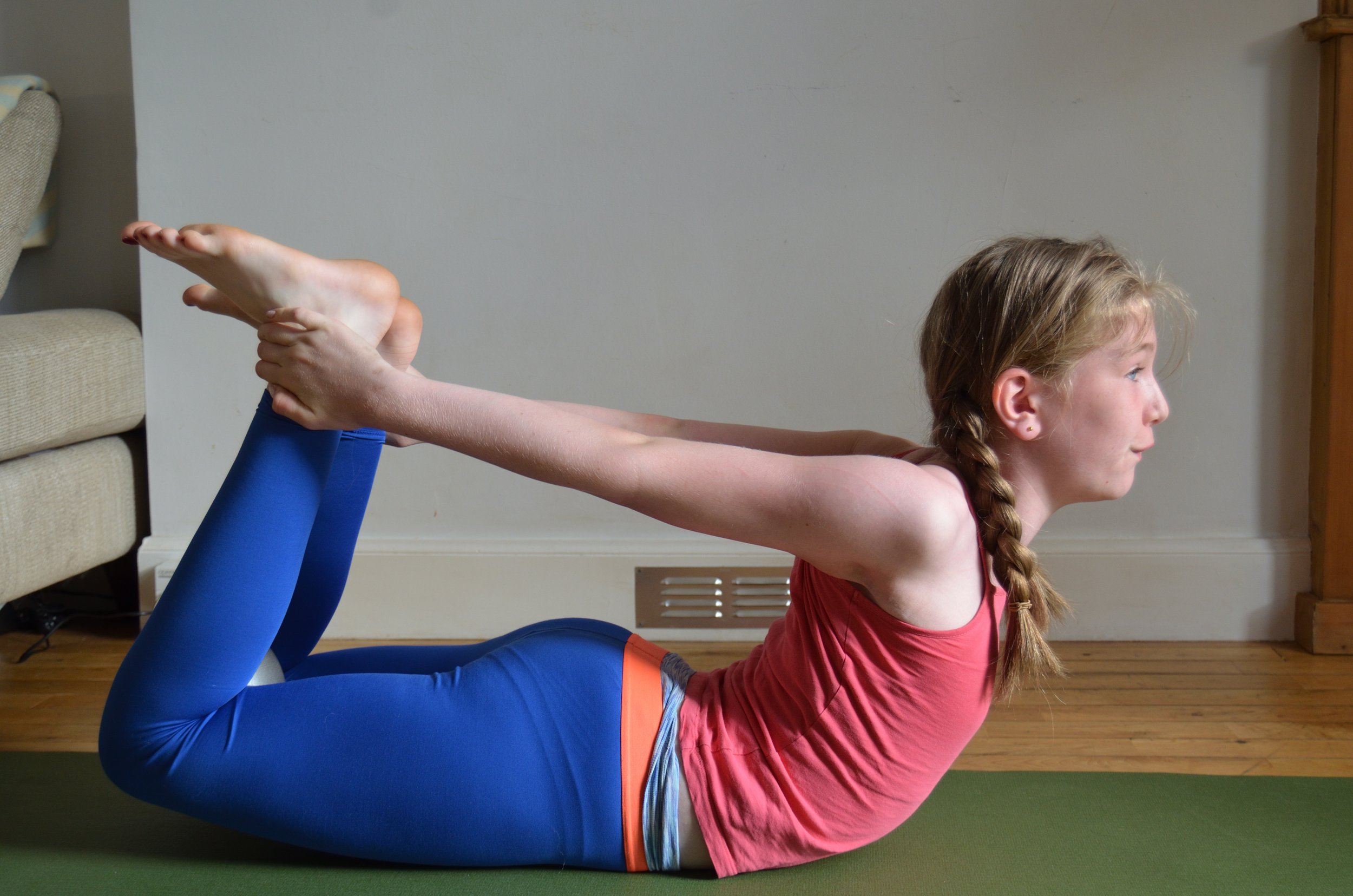
Child strengthening back muscles and integrating Primitive Reflexes
can teach children about the power within themselves, physically and mentally. It will give them a lifetime toolbox of techniques to self-calm, energise, be in the moment and accept – traits which can help navigate life’s challenges.
The best way to achieve this is to enrol in a Children’s Yoga Teacher Training course where the course is tailored to a specific age group.
One class does not fit all!
A 10-year-old will not be physically or mentally challenged by the same class plans as a 5-year-old. Most 10-year-olds will not want to be seen in the same class as a 5-year-old!
To run successful classes, each developmental stage has to be catered for. Teaching Yoga to children can be challenging, so why bother when there are easier audiences out there?
Teaching yoga to children will open your heart and stimulate your inner child in a way that even the best yoga practice could take years to achieve. You see life and yoga through fresh eyes – eyes that have not learned to judge and minds without barriers. You become one of the kids as you enter their world – a world where ego is left behind. It’s a great world, and it’s so much fun!
So do children really need to do yoga? Surely they get enough exercise?
Unfortunately, children no longer play the way they did 20 years ago. There are a number of reasons for this – working parents, safety fears, increased interest in computer games, etc. This is now affecting their physical and mental well-being. 15 years ago, when Veronica Greene founded Little Greene Yoga she would notice a dramatic change in a child’s posture once they started secondary school. This change was down to carrying extra books, studying, hunched over a desk or the simple awkwardness of adolescence! This posture adaptation is known as ‘forward head syndrome’.
About 5 years ago, she started to see this same postural imbalance happening among 8-12-year-olds. This coincided with the availability of various affordable electronic tablets. These devices are now part of everyday life, unfortunately, so is this posture, now often referred to as ‘text head’. What’s even more frightening is that it is now visible in children under 8!
“Most children no longer play the way they did 20 years ago. There are a number of reasons for this – working parents, safety fears, increased interest in computer games and so on. This is now affecting their physical and mental well-being.”

Children lengthening back body & opening their chest- Develops proprioception!
Children’s spines and bodies are now developing problems that can be avoided!
Their abdominal muscles (stomach) and chest muscles are now in a permanently shortened position; their neck is permanently tight; their shoulder blades flare out to the side, and the muscles of their upper back are weak and overstretched. This not only causes pain but also limits the movement of the diaphragm and the functioning of the lungs.
In effect, our children’s bodies are ageing rapidly. To combat this, we really need a program that can target all the developing issues in a child’s body. Yoga can achieve this and teach them awareness of how their bodies affect their mood.
Schools are increasingly keen to introduce Mindfulness programs to combat behaviour, emotional and mental health issues. Mindfulness has become the ‘in’ word, but Yoga is a complete Mindfulness Program encompassing mind and body and the connection between the two.
So how do we teach yoga to the younger age groups?
Purists state that yoga should be taught to children using only the true principles of yoga, and the use of stories or games distracts children from their bodies and minds. Others teach yoga to children using proven techniques to support their learning and encourage their participation. Young children learn holistically – by visual, auditory and kinaesthetic means at the same time. Some are more visual or auditory than others, but by combining the 3 you are encompassing all and magnifying the learning outcomes. According to Dr Margot Sunderland, an award-winning author and registered child and adult psychotherapist, “Used well, stories can become a vital part of a child’s healthy, emotional digestive system”. In her book “Using Storytelling as a Therapeutic Tool with Children”, Margot explains, “Children do not have sophisticated coping strategies for dealing with their intense or too difficult feelings. They do not have the inner resources for thinking them through or regulating their levels of emotional arousal. ”Feelings like happy or sad are easily understood by a child, but other emotions like frustration, tiredness, grief or anxiety are harder to conceptualise.
Many young children, on starting school, develop stomach aches or headaches but can’t recognise these as symptoms of anxiety from their new surroundings or life. Acting out yoga through the medium of story really comes into its own here! For example, a story being told through the expression of yoga could portray the main character as developing a tummy ache, then through a chance meeting with a wise, old owl, could learn that their emotions are creating this physical ache. Of course, the wise, old owl can then teach the child how to release this tension through simple breathing techniques. The child therefore learns, through story, that these feelings are normal and that there are solutions. Such storylines, through repetition, become ingrained in the mind, so the child’s future automatic response to tension in the tummy, will be to perform deep diaphragmatic ‘belly’ breathing.The topics that can be addressed are limitless – making friends; bullying; being different, etc.The bonus being that all this can be incorporated into every school’s Literacy Programme.
Of course, stories have been used for years by both teachers and parents as a way of teaching children valuable life lessons – everyone knows the story of “The Boy who Cried Wolf”.
There are many children’s courses out there, so choose one with a proven track record of running successful children’s classes. Does the training body still teach?
Do they offer support after course certification?
Choose wisely, as you’re not just changing your life but the life of every child you teach!
FOR MORE INFO: Veronica being interviewed by the Island Driven Podcast on the issues is schools today and the work she does.
Island Driven Podcast - interview about the struggles in schools and how to help (April ‘26)
Footnote: July 2026
Little Greene Yoga currently have 29 qualified instructors on Jersey & 2 on Guernsey. You can see the full list HERE.
Veronica has now been teaching adults for 34 years and teaching children in schools for 24 years.
She regularly delivers training in school classrooms, on the island, covering anxiety, nervous system, resilience & mind/body connection for both pupils and staff.
For further information on our School Programs and School INSET Training, click the individual links below